



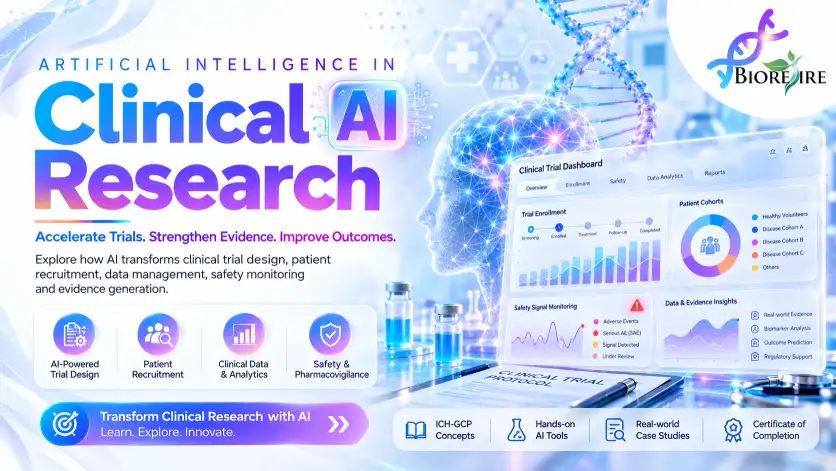
Explore the future of clinical research by combining the fundamentals of clinical trials, International Council for Harmonisation Good Clinical Practice (ICH-GCP), regulatory compliance, and Artificial Intelligence (AI).
This course introduces learners to clinical research fundamentals, clinical trial phases, study protocols, informed consent, ethics committee responsibilities, investigator and sponsor obligations, clinical data management, pharmacovigilance, and essential ICH-GCP principles. Discover how AI and Machine Learning can support clinical trial planning, patient recruitment, medical literature analysis, clinical data quality checks, safety monitoring, and research documentation.
Learn how AI-powered tools can streamline research workflows while maintaining participant safety, data integrity, confidentiality, and regulatory compliance.
What You Will Learn
Module 1: Fundamentals of Clinical Research
-
Introduction to clinical research and clinical trials.
-
Phases I, II, III, and IV of clinical trials.
-
Clinical trial terminology, study designs, and endpoints.
-
Roles of sponsors, investigators, CROs, and research coordinators.
Module 2: ICH-GCP Principles
-
Introduction to ICH and Good Clinical Practice.
-
Overview of ICH E6(R3) and its key concepts.
-
Ethical conduct of clinical trials and protection of participants.
-
Informed consent process and documentation.
-
Responsibilities of investigators, sponsors, and ethics committees.
-
Risk-based quality management and proportionate trial oversight.
-
Essential records, documentation, and data integrity.
-
Protocol compliance, deviations, and corrective and preventive actions (CAPA).
Module 3: Clinical Trial Operations
-
Clinical trial protocol development and review.
-
Site selection, feasibility, and site initiation.
-
Patient screening, recruitment, and retention.
-
Trial monitoring, source data verification, and quality control.
-
Trial master file (TMF) and investigator site file (ISF) fundamentals.
-
Clinical trial closeout and inspection readiness.
Module 4: Clinical Data Management
-
Introduction to clinical data management (CDM).
-
Case Report Forms (CRFs) and Electronic Data Capture (EDC).
-
Data validation, edit checks, and query management.
-
Database cleaning, reconciliation, and data quality.
-
Introduction to clinical datasets and clinical reporting.
Module 5: Pharmacovigilance and Drug Safety
-
Adverse Events (AEs) and Serious Adverse Events (SAEs).
-
Adverse Drug Reactions (ADRs) and safety reporting concepts.
-
Safety data review and signal detection fundamentals.
-
AI-assisted safety monitoring and human review.
Module 6: Artificial Intelligence in Clinical Research
-
Fundamentals of AI, Machine Learning, and Generative AI.
-
AI applications in clinical trial design and feasibility.
-
AI-assisted patient recruitment and eligibility screening.
-
Literature reviews, research summaries, and evidence synthesis.
-
Clinical data quality checks and anomaly detection.
-
AI-supported safety signal analysis and research reporting.
-
Prompt engineering for clinical research workflows.
Module 7: AI Tools and Practical Applications
-
Using AI tools to summarize scientific publications.
-
Creating structured literature review tables.
-
Drafting clinical research outlines and study documentation.
-
Building sample patient screening and trial feasibility workflows.
-
Exploring AI-assisted data analysis and reporting.
-
Identifying AI-generated errors and verifying outputs against reliable sources.
Module 8: Ethics, Regulations, and Responsible AI
-
Participant privacy, confidentiality, and data protection.
-
Research ethics and informed consent considerations.
-
AI bias, transparency, explainability, and human oversight.
-
Electronic records, audit trails, and computerized system validation concepts.
-
Regulatory awareness and responsible AI use in clinical research.
Who Should Join?
This course is suitable for students, graduates, and aspiring professionals from Biotechnology, Bioinformatics, Pharmacy, Life Sciences, Medicine, Nursing, Public Health, and Clinical Research.
It is also relevant to learners interested in Clinical Research Coordinator (CRC), Clinical Research Associate (CRA), Clinical Data Management (CDM), Pharmacovigilance, and AI-enabled healthcare research careers.
Why Learn with BioResire?
-
Build a foundation in clinical research and ICH-GCP concepts.
-
Understand clinical trial workflows and regulatory responsibilities.
-
Explore AI tools through practical, research-oriented exercises.
-
Develop skills in scientific literature analysis and data quality.
-
Understand the importance of participant safety, research ethics, and data integrity.
-
Prepare for emerging opportunities at the intersection of AI and clinical research.
Learning Outcome: Develop a foundational understanding of clinical trial operations, ICH-GCP principles, clinical data management, pharmacovigilance, and practical AI applications in clinical research.
Important Note: This course provides educational training. Completion does not automatically confer an official ICH-GCP certification or qualify learners to perform regulated clinical trial duties independently. AI outputs must be verified, and all clinical research activities must follow applicable regulations, approved protocols, and appropriate human oversight.
 Lessons: